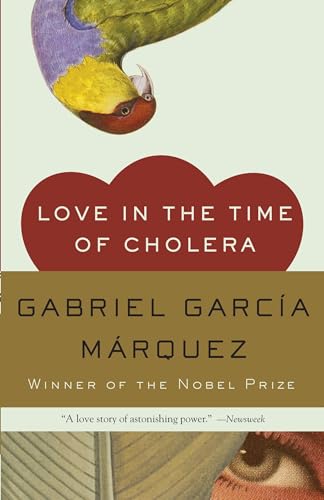


desertcart.com: Love in the Time of Cholera (Oprah's Book Club): 9780307389732: Garcia Marquez, Gabriel: Books Review: Passion, Obsession, and the Passage of Time - Gabriel Garcia Marquez’s Love in the Time of Cholera is a wonderful book on love, time, and the endurance of the human heart. Set in a lush Caribbean city during the late 19th and early 20th centuries, the novel follows the lifelong connection between Florentino Ariza and Fermina Daza. What begins as an intense youthful romance is abruptly severed, sending their lives in separate directions—yet Florentino remains steadfast in his devotion, waiting for decades in the hope that fate will bring them together once more. Marquez’s prose is nothing short of mesmerizing. His ability to blend lyrical storytelling with profound philosophical reflections makes the novel a deeply immersive experience. Love, in his vision, is not just an emotion but a force that evolves, perseveres, and sometimes even deceives. The novel doesn’t romanticize love in the traditional sense; instead, it explores its complexities—obsession, passion, companionship, etc. And the ways in which time reshapes our understanding of it. Beyond its central love story, the novel paints a vivid portrait of an era marked by social change, medical advancements, and the passage of generations. Marquez’s characters are flawed yet unforgettable, their desires and disappointments rendered with striking honesty. The narrative moves at a deliberate, almost meditative pace, which may not appeal to those looking for fast-moving plot twists. For readers willing to work with its rhythms, the reward is a fantastic story. Ultimately, Love in the Time of Cholera is a novel that lingers in the mind long after the final page. It challenges conventional notions of love and destiny, offering a deeply human exploration of what it means to love someone across a lifetime. Review: South American Period Piece - This novel, written by Nobel laureate Gabriel Garcia Marquez, is a period piece, set in a Caribbean port city (widely cited as Cartagena) in the late 19th and early 20th century. At its heart, it is the story of a tragic love triangle, involving Spanish maiden Fermina Daza, her first ardent suitor Florentino Ariza and her subsequent husband of over 50 years, Dr. Juvenal Urbino. The story begins with the twilight years of Fermina and Urbino and his accidental death. Ariza then makes his appearance, professing his undying and faithful love over the previous half century. We are then transported back to the childhood and subsequent courtships of the actors culminating in the marriage between Fermina and Juvenal and the heartbreak suffered by Florentino. Of primary interest to me were both the cultural and societal backdrop painted by the author. Late 19th century Spanish customs and mores were far different than those of today, with the Catholic Church playing an overarching role. Class and status were rigid and conscientiously adhered to, to the detriment of young Florentino. While the writing is certainly first rate and the imagery very effective, it is at times a little more florid than I generally prefer. There are long stretches of little or no action as the author expounds on the clothing worn by the actors, the weather, the landscape, the emotions and feelings of all involved. Not usually my cup of tea, but not beyond my capacity to appreciate, philistine that I am. That having been said, I found myself warming to the story, and perhaps becoming more comfortable with the style and substance relayed by the author. By its conclusion, I was very favorably disposed toward the novel. I did have one minor quibble however, and it revolved around Florentino's prodigious sexual appetite and conquests. Soon after the heartbreak of Fermina's marriage to Urbino, it is revealed that in the subsequent fifty years, Florentino conducted an astonishing 622 affairs, well documented in 25 notebooks. While it is not inconceivable that a fellow could sleep with 622 different women in fifty years, it is noted that the 622 "affairs" were not simply one night stands, or visits with whores, but "affairs of the heart". This seems to be wholly unrealistic. Taking into account the population of the city itself, the strict Catholic mores in place and the simple math, it seems highly unlikely that any man could have accumulated such an impressive record. Maybe I'm simply not trying hard enough.

| Best Sellers Rank | #13,089 in Books ( See Top 100 in Books ) #1 in Caribbean & Latin American Literature #497 in Classic Literature & Fiction #629 in Literary Fiction (Books) |
| Customer Reviews | 4.3 4.3 out of 5 stars (10,093) |
| Dimensions | 5.2 x 0.84 x 7.99 inches |
| Edition | Reprint |
| ISBN-10 | 0307389731 |
| ISBN-13 | 978-0307389732 |
| Item Weight | 2.31 pounds |
| Language | English |
| Part of series | MARQUEZ 2014 |
| Print length | 368 pages |
| Publication date | October 5, 2007 |
| Publisher | Vintage |
C**S
Passion, Obsession, and the Passage of Time
Gabriel Garcia Marquez’s Love in the Time of Cholera is a wonderful book on love, time, and the endurance of the human heart. Set in a lush Caribbean city during the late 19th and early 20th centuries, the novel follows the lifelong connection between Florentino Ariza and Fermina Daza. What begins as an intense youthful romance is abruptly severed, sending their lives in separate directions—yet Florentino remains steadfast in his devotion, waiting for decades in the hope that fate will bring them together once more. Marquez’s prose is nothing short of mesmerizing. His ability to blend lyrical storytelling with profound philosophical reflections makes the novel a deeply immersive experience. Love, in his vision, is not just an emotion but a force that evolves, perseveres, and sometimes even deceives. The novel doesn’t romanticize love in the traditional sense; instead, it explores its complexities—obsession, passion, companionship, etc. And the ways in which time reshapes our understanding of it. Beyond its central love story, the novel paints a vivid portrait of an era marked by social change, medical advancements, and the passage of generations. Marquez’s characters are flawed yet unforgettable, their desires and disappointments rendered with striking honesty. The narrative moves at a deliberate, almost meditative pace, which may not appeal to those looking for fast-moving plot twists. For readers willing to work with its rhythms, the reward is a fantastic story. Ultimately, Love in the Time of Cholera is a novel that lingers in the mind long after the final page. It challenges conventional notions of love and destiny, offering a deeply human exploration of what it means to love someone across a lifetime.
S**Y
South American Period Piece
This novel, written by Nobel laureate Gabriel Garcia Marquez, is a period piece, set in a Caribbean port city (widely cited as Cartagena) in the late 19th and early 20th century. At its heart, it is the story of a tragic love triangle, involving Spanish maiden Fermina Daza, her first ardent suitor Florentino Ariza and her subsequent husband of over 50 years, Dr. Juvenal Urbino. The story begins with the twilight years of Fermina and Urbino and his accidental death. Ariza then makes his appearance, professing his undying and faithful love over the previous half century. We are then transported back to the childhood and subsequent courtships of the actors culminating in the marriage between Fermina and Juvenal and the heartbreak suffered by Florentino. Of primary interest to me were both the cultural and societal backdrop painted by the author. Late 19th century Spanish customs and mores were far different than those of today, with the Catholic Church playing an overarching role. Class and status were rigid and conscientiously adhered to, to the detriment of young Florentino. While the writing is certainly first rate and the imagery very effective, it is at times a little more florid than I generally prefer. There are long stretches of little or no action as the author expounds on the clothing worn by the actors, the weather, the landscape, the emotions and feelings of all involved. Not usually my cup of tea, but not beyond my capacity to appreciate, philistine that I am. That having been said, I found myself warming to the story, and perhaps becoming more comfortable with the style and substance relayed by the author. By its conclusion, I was very favorably disposed toward the novel. I did have one minor quibble however, and it revolved around Florentino's prodigious sexual appetite and conquests. Soon after the heartbreak of Fermina's marriage to Urbino, it is revealed that in the subsequent fifty years, Florentino conducted an astonishing 622 affairs, well documented in 25 notebooks. While it is not inconceivable that a fellow could sleep with 622 different women in fifty years, it is noted that the 622 "affairs" were not simply one night stands, or visits with whores, but "affairs of the heart". This seems to be wholly unrealistic. Taking into account the population of the city itself, the strict Catholic mores in place and the simple math, it seems highly unlikely that any man could have accumulated such an impressive record. Maybe I'm simply not trying hard enough.
M**S
Well written
I was never going to read this, but an old friend from high school said it was his favorite book. I got it for a penny here, why not? And I am glad I did. The story of Florentino and Fermina over fifty years is not dull or predictable. They fall in love as teenagers but that gets all sundered and she marries a rich doctor and lives in a big house in the sweltering tropics of Colombia. Fermina has kids and lives as best she can, but her rich husband is a disappointment. Oh not that he is boring- the book shows him as a character in his own right which makes it fun to read. You get engrossed in all the gross goings-on in this town. So Florentino does not wait in a monastery for his love to become a widow, No- he goes out and beds as many women as he can without loving them or committing to them. In fact, he is a sleazy jerk. Not to give too much away but he turns into a dirty old man before Fermina is available again. Not a likable character but not boring in the least, you really want to see what becomes of him. Also, it's a quest you want to see fulfilled. So the book is rich with imagery and glorious poetic writing and makes you feel like you are there in sweaty Colombia as these people live their messy lives. Worth the effort.
M**R
A timeless book, summing up people's emotions in a manner that one can relate to. Gabriel Garcia Marquez suceedes because he writes what the individual thinks. A most enjoyable read
A**.
Muy buen producto, coincide con lo ofertado
N**N
I'm happy I could find this edition.
I**A
Schnelle Lieferung, freue mich aufs lesen
K**H
Heartwarming book about enduring love against all odds. Marcia writes eloquently, and his beautiful descriptions of life in Caribbean - Columbia make you feel like you're there and then. Highly recommended read.
Trustpilot
2 weeks ago
2 months ago


